Uncategorized

HP to Change Name to EDS (or at least it should)

Today, HP announced that the company would be killing its mobile unit, bringing an end to the soap opera life of Palm. They also confirmed, apparently, that they are looking to “spin off” the Personal Systems division and get out of the PC business.  And they may be interested in buying an enterprise search company.

This should come as no real surprise to anyone who’s been watching HP for any length of time.  While the leadership changes, the song remains the same: the grass is always greener in whatever business HP isn’t in, until it gets into it.  In fact, with the scramble to divest the PC unit (and whatever remaining Compaq DNA remains in the company), HP has apparently decided it wants to copy IBM and become a services company with enterprise software and servers.

I have a suggestion that should help HP’s executive suite finally exorcise the demons of past management, and move the company down the same path that IBM, Unisys, and others that it once battled in the mini/midrange/workstation space have followed with varying success: change the company’s name to EDS.  Come on. You know that’s who you want to be.

HP’s services unit, formerly known as the company called EDS, is everywhere.  It is clearly the center of what’s left of HP’s business once you get past that whole printer thing.  Managed services and cloud are core to the former EDS’ capabilities.  There are more HP Services people at the Defense Information Systems Agency than from any other contractor, I’ve been told.  The Navy is, despite its efforts to get out from under NMCI, still wedded to it for the foreseeable future because HP owns the infrastructure and the intellectual property that runs the network–and the Navy’s NGEN efforts have stalled.

The death of webOS is sad, but sort of moot at this point.  HP stalled its efforts for so long that developers (who were in love with the JavaScript-based environment at one point) had mostly given up on ever having enough of an audience to really take it seriously.  The OuchPad…er, TouchPad, was late to market, and a poor substitute for the second-generation iPad.  Those predicting the marriage of Palm to HP was doomed from the start because of organizational culture issues were numerous, but even cynics like me held out hope that HP had enough engineering chutzpah left to do something cool.

Sadly, no.

The same is true of the PC division.  A few days ago, I had heard comments about how HP wanted to rebrand itself as a high-end player, like Apple down the road in Cupertino. But HP’s systems are known mostly as Dell competitors for the race to the bottom of the discount laptop list.  I don’t hear complaints about HP servers, though.

So, do it, HP. You know you want to.  Change your name to EDS.  All your managed services customers never got used to those HP nametags anyway.  Your people are still called EDS in the field despite the new business cards.
Standard
Uncategorized

Microsoft’s Cloud Service Hints at Future for Enterprise “Desktop”

Originally posted at : Internet Evolution – Sean Gallagher – Cloud Service Is a Portent for Enterprise Desktops.

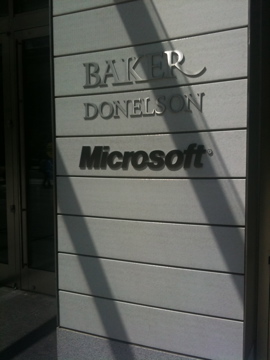
Microsoft's offices in downtown DC

Microsoft’s K Street office entrance

A day before the 30th anniversary of the unveiling of the personal computer, I was at a Microsoft media event in Washington. Called “The Future of Federal Work,” the event was intended to show off Microsoft’s Office 365 cloud-based collaboration and productivity platform in the context of how federal agencies will use it. But the event also offered a look at how Microsoft envisions the future of business computing in general, and what place the PC holds in that future.

With the rise of the Web and cloud computing, IBM’s Mark Dean has said that we’ve entered the “post-PC” era. Microsoft vice president of communications Frank Shaw says he prefers to call it the “PC-plus” era, since the PC is becoming just one of many devices people use to access and work with data.

The PC isn’t dead — it’s just becoming harder and harder to define what a PC is. And based on what we’ve seen of Microsoft’s plans for the Windows operating system, the divisions between cloud, desktop, and mobile device applications are going to get even more blurry.

Office 365 itself is evolutionary rather than revolutionary. The biggest change may be in the business model for delivery. This platform gets customers out of the business of maintaining software infrastructure and the servers that run it, providing these elements through the cloud. And in the case of the government, that cloud is a private one.

Chris Niehaus

Chris Niehaus

Chris Neihaus, director of innovation for Microsoft’s US public sector business, said at last week’s event that Microsoft “used to be like Blockbuster, and now we’re evolving our productivity business to be more like Netflix.” As with Netflix, you can still get software delivered on disks, or you can download it on demand from the network on whatever device you have handy.

The demo of Office 365 was conducted on a set of giant touch-screens in Microsoft’s new Innovation and Policy Center in Washington. It was intended to show that the service bridges from thick-client desktop to browser to mobile device app with the same user interface, and it largely delivers the same user experience.

“The features and capability might not be at parity” across all devices, Microsoft public sector CTO Susie Adams said. “But the user experience is the same from a productivity experience.”

For many large enterprises, including government agencies, that commonality of experience, plus a previously installed base of Microsoft’s productivity tools, make Office 365 awfully attractive. This also means that previous investments in leveraging Windows management tools to enforce user authentication and security policies are largely preserved. And enterprises don’t have to invest in additional user and IT professional training to support this deployment.

A number of federal agencies are already using the service. Those that bought the predecessor Business Productivity Online Services-Federal (BPOS-F), including the Department of Agriculture, are being converted to Office 365 as the new service is being certified for compliance with federal information security management standards.

One part of Microsoft’s vision for the “future of work” was only hinted at during the demos. That part is Windows 8, the next release of Microsoft’s operating system, which will prominently feature applications based on HTML5 and JavaScript — already the standards for cross-platform mobile application development. By leveraging touch, clouds, and Web services, the next generation of Windows will further blur the line between what happens locally on a device and what happens in the cloud.

That approach isn’t unique. In fact, some may see Microsoft’s direction as a concession to victories by Apple and Google in the mobile realm, as well as by the Web over Windows as a development platform. But if people end up running Windows apps on their iPads and Androids, I hardly think Microsoft will consider that surrender.

— Sean Gallagher is an award-winning IT journalist and the former head of InformationWeekLabs. Gallagher is now an independent journalist and technology consultant based in Baltimore. He can be reached at: gallagher.sean.m@gmail.com.


Standard